A research project funded by the Dutch Research Council (NWO), exploring the fundamental tension between secrecy claims and transparency needs in the context of EU digital and data legislation. Stay tuned for updates from the project as well as scholarly and regulatory developments and news.
As part of our NWO-funded project ‘Artificial Secrecy’, we are very excited to be hosting at the Institute for Information Law (IViR) a Civil Society Workshop in collaboration with the Digital Freedom Fund. On the 7th of October, several European civil society organisations will join us in conversations on legal and technical obstacles, as well as alternative avenues for accessing data and information on AI and digital technologies.
Looking forward to discovering what challenges and barriers these actors face and finally meeting in person at IViR.
Thank you kindly to the Digital Freedom Fund, Dr. Kristina Irion and Dr. Plixavra Vogiatzoglou for helping in bringing such a diverse pool of experts together!
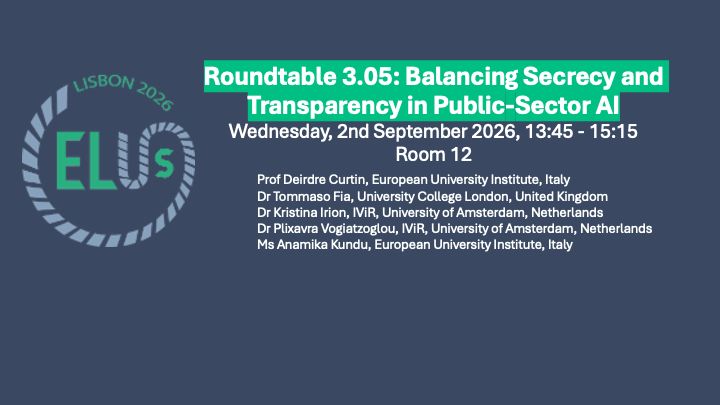
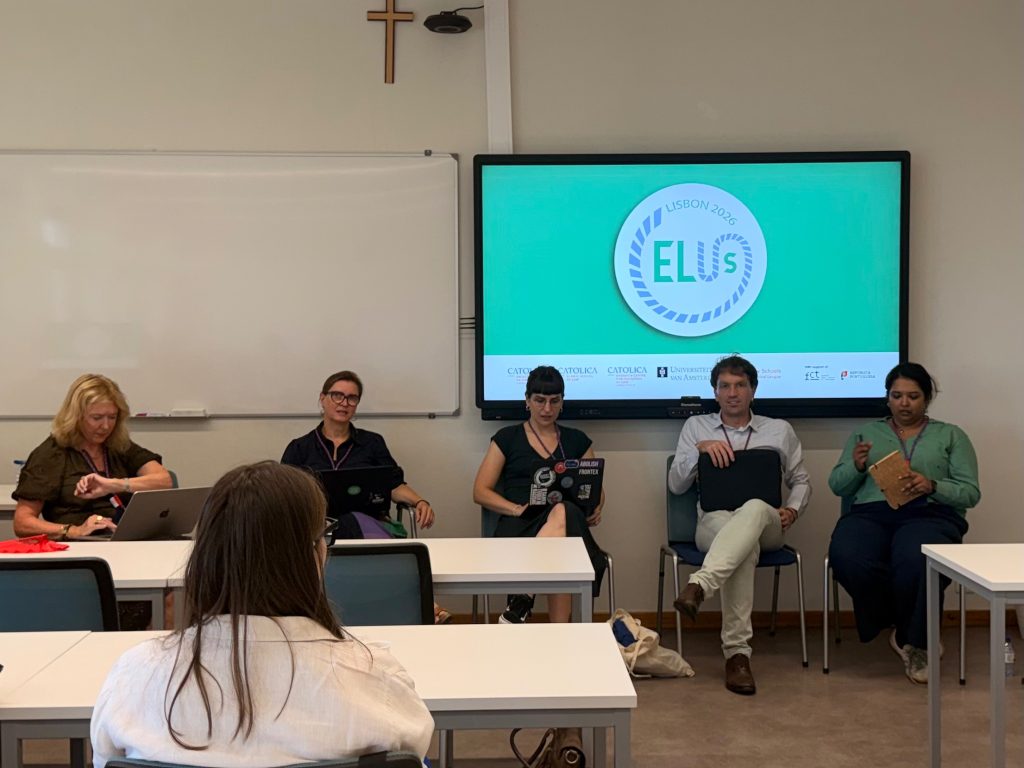
Panel 3.05: Roundtable – Balancing Secrecy and Transparency in Public-Sector AI
This roundtable explored the institutional, legal and societal drivers of secrecy of AI systems, their interplay with transparency and their implications for public governance. The debate considered the relevant frameworks (across the EU digital rulebook) that build both secrecy and transparency, and discussed approaches to (re-)shaping transparency in the public interest. In doing so, it touched on the different sectors and areas of interest and teased out the broader implications and lessons for a more sensible equilibrium between public and private interests in governing public-sector AI in the EU.
The session was chaired by Professor Deirdre Curtin (EUI), in conversation with Dr. Kristina Irion (IViR), Dr. Plixavra Vogiatzoglou (IViR), Dr. Tommaso Fia (UCL), and PhD Researcher Anamika Kundu (EUI).
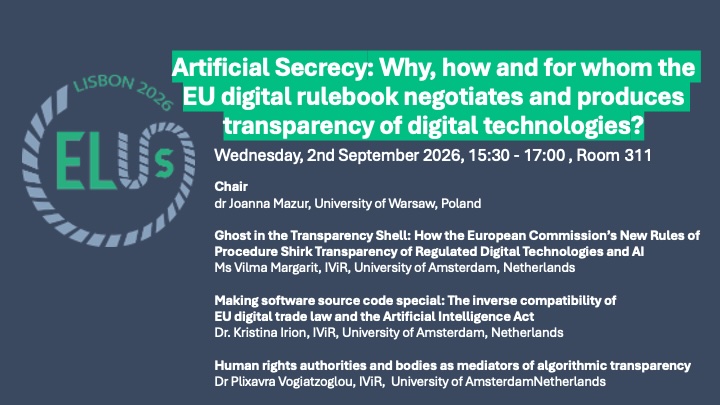
Panel 4.20: Artificial Secrecy: Why, how and for whom the EU digital rulebook negotiates and produces transparency of digital technologies?
This panel explored pertinent questions at the transparency versus confidentiality nexus, including: how do regulatory authorities, in particular the European Commission, apply freedom of information laws when confidentiality and trade secret claims are raised; how a digital trade law provision protecting source code of software is used to weaken the AI Act’s rules on market conformity assessments and supervision of AI systems; how human rights authorities and bodies can harness their powers to access commercial information necessary for algorithmic transparency. Underlying these is the fundamental question of how EU law negotiates transparency and confidentiality in relation to regulated digital technologies, and whether this can effectively mitigate the power asymmetries between citizens, public-interest bodies, and private actors with strong commercial interests.
The session was chaired by Joanna Mazur (University of Warsaw), in conversation with Dr. Kristina Irion (IViR), Dr. Plixavra Vogiatzoglou (IViR), and PhD Candidate Vilma Margarit (IViR).
Delangue, whose company provides a database of AI models to developers, called for a fully transparent review of the incident, which has led to expressions of concern over safety standards at OpenAI and within frontier AI labs.
Writing that he had asked for “radical transparency” from OpenAI, Delangue said: “Let’s release the traces from the ‘rogue’ agents so the entire research community can study what happened.” Calling for extra funding from OpenAI to build protection against AI, he added: “Let’s commit $100M in compute from OAI to help the Hugging Face community build powerful cyber defenses with the best open and closed models.”
The Charter of Fundamental Rights of the European Union states unequivocally: ‘Any citizen of the Union, and any natural or legal person residing or having its registered office in a member state, has a right of access to documents of the institutions, bodies, offices and agencies of the Union, whatever their medium’.
Despite this, the EU is increasingly hiding things from journalists, researchers and members of civil society.
On 19 June 2026, we had the chance to present our work in progress paper at the ‘Algorithmic Transparency and Explainability’ panel during TILTing Perspectives 2026, the 9th edition of TILT’s biennial conference, held this year in Tilburg under the theme “Between Values and Innovation: Tech Governance in a Multicentric World.”
Debates about algorithmic transparency tend to focus on the technology itself, such as model architecture, training data, explainability tools. Our panel contribution pushed the conversation with a simple provocation: the appearance of technological determinism is convenient for those who hold power over social choices in technology. Before we can scrutinise an algorithm, we often need the institutional documents that describe it, and increasingly, the European Commission is finding ways not to share them.
The starting point is Regulation (EC) 1049/2001, the EU’s access to institutional documents framework. Running alongside it is the General Presumption of Confidentiality (GPC), a judge-made device that lets institutions refuse a document request simply because it falls into a recognised category, without showing disclosure would cause concrete harm. Safeguards exist in principle, such as the duty to give reasons, rebuttal, partial disclosure, but they’re increasingly theoretical in the digital sector. Especially problematic is the “overriding public interest” (OPI) test, which has become dangerously arbitrary in practice.
The paper then provides 3 concrete case studies, illustrating how the European Commission is using the GPC as a default shield rather than a calibrated exception.
Commission Decision (EU) 2024/3080, extending confidentiality to DMA/DSA procedure documents. Currently pending before the CJEU in the case of De Capitani and Others v Commission.
X’s denied DSA risk impact assessment, where a journalist’s request of access has been refused on commercial/investigation grounds; the European Ombudswoman declared this maladministration, but the Commission has not changed its course.
Data centres’ environmental reporting, where a provision lobbied by Big Tech keeps energy and water-use data confidential despite the Aarhus Regulation’s rule that emissions-related environmental information cannot be withheld on commercial grounds. The European Parliament has declared this unlawful.
This echoes similar patterns elsewhere in EU digital regulation (e.g.; GDPR adequacy decisions, DMA gatekeepers compliance, and DSA supervisory powers), widening the gap between technological elites and the public.
This work-in-progress paper is co-authored by Vilma Margarit Nikolaeva, Dr. Plixavra Vogiatzoglou, and Dr. Kristina Irion.
Part of “Artificial Secrecy,” funded by the Dutch Research Council (NWO).
On Thursday 21 May we held our CPDP panel centered around the ‘rights of access to corporate documentations and the trade secrets defence‘.
The EU digital rulebook strikes a balance betweentransparency for affected users and actors’ claims of confidentiality. The most prominent ex post transparency mechanism is the data subject access right to personal data under the General Data Protection Regulation. Yet, such access rights can be restricted in order to protect the rights and freedoms of others, including trade secrets. While jurisprudence about the balancing between conflicting positions of rights is consistent about the right to access corporate documentation such as log files in practice this often leads to a protracted legal battle.
This panel revisited experiences with trade secret claims by providers of digital technologies, the responsibilities of regulators and the impact of the digital omnibus on transparency rights.
The panel was guided by the following questions:
What qualifies as a trade secret and as confidential business information?
How do trade secret claims affect transparency rights?
What balance has the law struck between transparency rights and trade secret claims?
What is the role of regulators, and what is the impact of the Digital Omnibus on transparency rights?
Moderated by Vilma Margarit (IViR) and in conversation with:
The EU Ombudswoman opened an inquiry into the Commission’s failure to reply to a submission on ethical concerns about generative AI systems’ compliance with the EU Charter of Fundamental Rights. The central issues of the inquiry include the failure to follow the law (Art. 4 ECGAB) and failure to deal properly with requests for information (Art. 22 ECGAB).
“In his opinion, Advocate General Athanasios Rantos proposes that the Court of Justice dismiss both appeals and uphold the judgments of the General Court”, the court said in a statement, adding that Rantos said in his non-binding opinion that the General Court “did not err in law in assessing the necessity of the information requested or in examining the safeguards for its provision.”
X (formerly Twitter) is being sued in Germany by NGOs over Digital Services Act obligations, for a second time. Researchers want access to platform data before the key Hungarian parliamentary election in April.